

5.9K
Downloads
16
Episodes
Interviews with the main authors of key publication on oral regeneration topics.
Episodes

Jun 22, 2026
Jun 22, 2026
39 min
What are the key factors for successful bone augmentation in the edentulous maxilla?
As part of the current Oral Regeneration Topic "Advanced Bone Augmentation in the Edentulous Maxilla", Hom-Lay Wang and Giulia Brunello discuss the findings and clinical recommendations of the Global Consensus for Clinical Guidelines (GCCG) on bone augmentation in the edentulous maxilla.
In this Key Publication Interview, they explore treatment outcomes, clinical indications, and decision-making in complex regenerative cases. They also reflect on the consensus process and its implications for daily practice.
Join them to explore the latest evidence in advanced bone augmentation.

Dec 2, 2025
Dec 2, 2025
29 min
What if a simple change in surgical technique could transform healing?
As part of the current Oral Regeneration Topic “Minimally Invasive Surgical Therapy,” Rino Burkhardt was interviewed by Albert Chen to share the story behind his landmark study, “Coverage of Localized Gingival Recessions: Comparison of Micro- and Macrosurgical Technique,” which challenged traditional methods and reshaped the way we think about soft tissue healing.
In the interview, Burkhardt discusses how microsurgical techniques improve blood perfusion, speed up recovery, and influence long-term outcomes. He also reflects on the challenges of designing the study, the innovative use of angiography, and why deliberate, hands-on training is just as important as the surgical tools themselves.
Join them and explore the science behind precision and healing.
May 9, 2025
May 9, 2025
35 min
Anina Zürcher spoke with Mark Bartold, the first author of our key publication, "Molecular and cell biology of the gingiva." With over 420 citations, this paper has made a significant impact on the field of oral regeneration.
In the interview, Bartold explains the roles of different cells—like fibroblasts, immune cells, and epithelial cells—in tissue health, inflammation, healing, and periodontal regeneration. He also highlights the difference between regeneration and reconstruction and why understanding the tissues and molecular pathways involved is key to achieving predictable outcomes.
Nov 11, 2024
Nov 11, 2024
1 hr 6 min
Join us for an in-depth conversation with William V. Giannobile, interviewed by Sejal Thacker, as he reflects on his key publication, Platelet-derived growth factor stimulates bone fill and rate of attachment level gain. Giannobile discusses the groundbreaking development of recombinant human platelet-derived growth factors (PDGFs) and their pivotal role in oral tissue regeneration. He traces PDGF's journey from discovery to clinical application, sharing insights into the science, trials and regulatory steps that brought this innovation to patients. From early tissue culture studies to regenerative therapies for periodontal disease, Giannobile details the research process and rigorous trials required to develop safe and effective treatments. This is a must for anyone interested in the latest developments in oral tissue regeneration!
May 7, 2024
May 7, 2024
46 min
For the current Oral Regeneration Topic "Interdisciplinary strategies in dentistry", Jeniffer Perussolo spoke with Karin Jepsen, the first author of our key publication "The effect of timing of orthodontic therapy on the outcomes of regenerative periodontal surgery in patients with stage IV periodontitis". In this discussion, you'll discover the benefits of combining orthodontic therapy with periodontal surgery.
According to Jepsen, when treating stage IV periodontitis, orthodontic therapy can be initiated as early as four weeks after regenerative surgery, with favourable outcomes and shorter overall treatment time. She outlines the prerequisites for this approach and discusses the future prospects for interdisciplinary treatment.
Nov 27, 2023
Nov 27, 2023
42 min
For the current Oral Regeneration Topic "Digital Technologies in Oral Regeneration", Mia Geisinger spoke with Giulio Rasperini, first author of our key publication "3D-printed bioresorbable scaffold for periodontal repair". In this interview, you will learn more about the potential uses of bioprinting in periodontal regeneration.
According to Rasperini, saving a tooth is more than just protecting the patient's living tissue – it's a worthwhile effort. In his quest to preserve teeth, he has explored tissue engineering methods for reconstructing complex structures like the periodontium. Printed biomaterials represent promising tools, offering customisation for size, configuration, and architecture of a specific defect. Rasperini expects that future research will shed more light on bioprinting in periodontal regeneration, leading to personalised treatment plans and improved long-term patient outcomes.
May 24, 2023
May 24, 2023
33 min
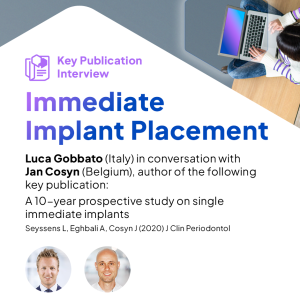
For the current Oral Regeneration Topic, Luca Gobbato spoke with Jan Cosyn, first author of our key publication on "Immediate Implant Placement". In this interview, you'll learn about the main key take aways of the 10-year prospective study, which offers valuable insights into the long-term outcomes of immediate placed implants.
According to Cosyn, immediate implant placement can be a safe clinical procedure and also a fast treatment approach that can greatly benefit patients. By ensuring that certain pre-requisites are met and implementing immediate provisionalisation, you can achieve a predictable outcome and ensure patient satisfaction. Furthermore, Cosyn reveals the crucial factors that will help you achieve a perfect three-dimensional implant position.
Sep 16, 2022
Sep 16, 2022
41 min
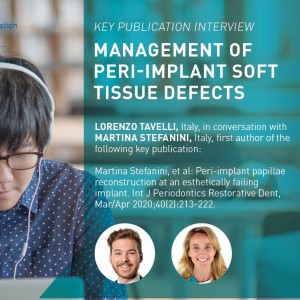
For this Oral Regeneration Topic, Lorenzo Tavelli spoke with Martina Stefanini, first author of our key publication on the management of peri-implant soft tissue defects. It aimed to describe an approach to restore a buccal soft tissue dehiscence combined with the loss of the peri-implant papillae and loss of periodontal attachment on the adjacent teeth.
In the interview, Stefanini reveals how the focus of implant dentistry has shifted from bone to soft-tissue management over the years, and she describes the increased aesthetical awareness of patients and clinicians during the prosthetic rehabilitation of implant placement. While working with a surgical guide, ensuring sufficient soft-tissue thickness and using a connective tissue graft are her holy grails when placing an implant in the aesthetic zone. Stefanini reveals even deeper knowledge and crucial details that lead her to a successful clinical and aesthetical outcome.
May 2, 2022
May 2, 2022
1 hr 7 min
For the current Oral Regeneration Topic Nikolaos Tatarakis spoke with Bjarni Pjetursson and his key publication on Sinus Augmentation. It aimed to systematically review the outcome of sinus floor elevation and the survival of implants inserted in combination with sinus floor elevation. In the interview, Pjetursson also reveals what has changed clinically since the study was published and how this would affect the study design today. Other interesting points Pjetursson raises are the much-discussed clinical practice of using a membrane over the sinus window, the graft material and whether or not to use a graft.
Nov 2, 2021
Nov 2, 2021
38 min
For the current Oral Regeneration Topic Jia-Hui Fu spoke with Daniel Thoma and his key publication on Soft Tissue Augmentation/Thickening. It aimed to test whether soft tissue augmentation with a newly developed collagen matrix (CM) leads to volume gain in chronic ridge defects, similar to those obtained by an autogenous subepithelial connective tissue graft (SCTG).
The interview begins with the surprising fact that Thoma is actually primarily trained in prosthodontics and implant dentistry, and he only started to realise the importance of soft tissue when he had to restore implants. As he said, 20 years ago implants were all about bone, and it was only over time that the realisation that a good amount of soft tissue was associated with a good aesthetic outcome took hold. After years of using the autogenous soft tissue, he became interested in alternatives to the latter to increase patient comfort.